DEBRIEF

A lessons-learned workshop where everyone talks and no card carries a name.

  • Trailer, 0:58
  • Full demo, 1:50
  • Built in a day

Trailer

58 seconds, with sound and captions.

The meeting at the start is staged. The app on screen is the real one, recorded while it ran a session for a fictional project; the counter of people joining is sped up, and the join code’s QR and address are covered. The cards, the votes and the action are made up, and all four voices are synthetic.
Read the transcript

On screen: A grey card, held still: a Sheldon Smith film. The project is over.

Every project ends with a debrief.

On screen: A staged meeting, one card at a time, every card the same figure in profile with an orange smear across the eyes. The boss: his words light up as he says them. The veteran agrees. The rookie starts a sentence and stops. The quiet one’s card stays empty, and under it: says nothing. Where a name would be, a smear. A line reads: a staged meeting, everyone in it is fictional.

The boss: Overall? I think it went really well. The veteran: Yeah. Agreed. The rookie: Actually, I think the... The new ones stop short. The quiet ones say nothing.

On screen: All five cast cards in a row, The skeptic among them, every one the same figure. Under them: the real problems never come out. Then nothing moves.

So the real problems never come out.

On screen: The title, Debrief, on a black band under the profile portrait with the orange smear across the eyes. The lines The meeting after a project, No names, and Everyone talks come up as they are said.

This is Debrief. It runs the meeting after a project, with the names taken off. So everyone says what really happened.

On screen: Exhibit A, recordings of the real app in a frame. The facilitator’s screen shows a session code and a counter climbing to six joined; its QR code and the address under it are covered by black blocks with the orange smear across them. A participant types the code while nobody speaks, then types a card.

Everyone joins from their phone. [Keys click. Nobody speaks] Everyone writes alone. No name on it.

On screen: Exhibit B. On the facilitator’s screen five cards appear at once. Then the cards are sorted under named themes.

Every card shows up at once, so nobody just follows the boss. AI sorts them into themes.

On screen: Exhibit C. Vote totals appear beside the themes. An action is typed, then its owner, then its date. The pointer reaches a button marked Download Excel export.

A blind vote picks what matters most. It ends with actions. Each one has an owner and a date. One click, and it’s in Excel.

On screen: Two black cards. Honest answers, from the whole room. Then: built in a day, used in a real session the next day.

Honest answers, from the whole room. Built in a day.

On screen: The Debrief poster beside the words Now showing, then a billing block and the line Anonymous by design.

Debrief. Now showing. [One last hit. The chord rings out]

What it does

People say what really went wrong when nobody can tell who said it. A facilitator projects the session and the team joins from their phones with a six-character code. First comes silent writing. Then every card is revealed at once, with no names attached. AI proposes the themes and the room adjusts them. Blind voting decides what gets discussed. The session ends with actions that have owners and dates, agreed in the open, and one click exports a lessons-learned register to Excel.

A session, start to finish

1Join and write, from a phone
Session code
K4P9WT
What would you advise the next phase team to change?Specs changed after sign-off, and nobody told the testers.
No name on itAdd card
2Every card at once, sorted
Themes, proposed by AI6 cards, no names
Handoffs
Nobody owned the handoffSpecs changed after sign-off
Tools
Two trackers, two truthsAccess came a week late
Timing
Test data arrived lateReview squeezed into Friday
Blind voteEach dot is one vote.
3Actions, then the register
Actions, agreed in the open
Name one owner for every handoff
OwnerDanaDueDec 4
Freeze the spec at sign-off
OwnerOmarDueDec 11
Export to ExcelWith a lessons-learned register
Every card, vote, name and date here is made up.

The full demo

Best watched full screen. Captions are on by default.

All of the data in it is fictional.

1 minute 50 seconds, with captions.

Best watched full screen. Captions are on by default.

All of the data in it is fictional.

Read the transcript

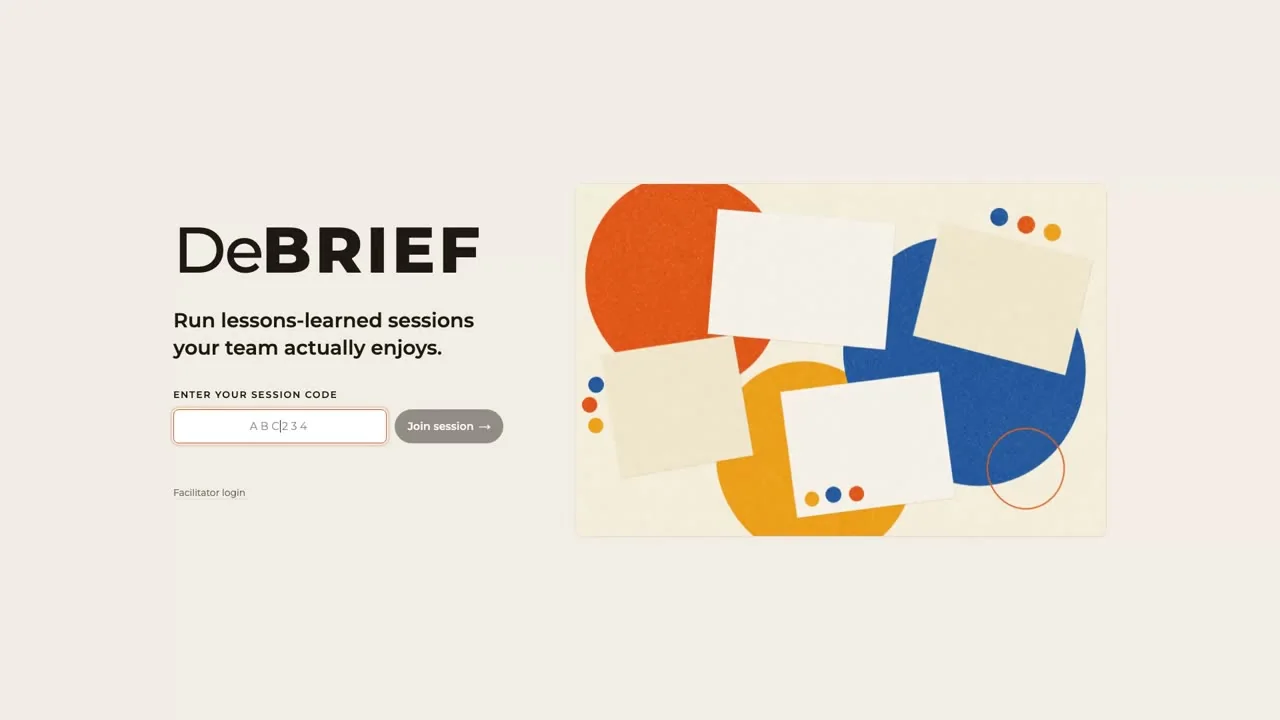
On screen: The landing page. A session code is typed into the join box.

This is Debrief, a tool we built for running lessons-learned sessions your team actually enjoys. Everyone joins from their own laptop with a six-character code. No accounts, no installs.

On screen: The facilitator console, with the session code and a counter that climbs as people join. A dark block covers the QR code and the address under it.

The facilitator projects the session, and as the team scans the code, the counter climbs. Everything that happens next is anonymous by design. The tool never records who wrote what.

On screen: A participant types a card under the prompt about what to change. Then the console shows the card counts for both prompts and a running timer.

The session opens with silent writing, on two prompts: what should we keep, and what should we change. Everyone types at the same time, and nobody sees anyone else’s cards, so the quiet voices carry exactly the same weight as the loud ones. A timer keeps the room honest.

On screen: On the console, every card appears at once. One click sorts them into named themes.

Then, the reveal. Every card appears at once, with no names attached. And with one click, AI reads every card and proposes the themes. The room adjusts them together. The tool suggests, people decide.

On screen: A participant spends four votes across the themes. On the console the totals are revealed and the themes re-sort.

Next, blind voting. Everyone gets four votes on their own screen, and the totals stay hidden until the facilitator reveals them, so nobody follows the crowd. The top themes earn the discussion time.

On screen: The top theme is open on the console. A root-cause note is typed live, then an action is added with an owner and a date.

For each top theme, the team digs down to the root cause, and it’s captured live for everyone to see. Then come the commitments: actions with a named owner and a date, typed on screen in front of the whole room.

On screen: A participant rates the session. The console closes on a summary: six participants, eight cards, seven themes, one action, a rating of 4.8 out of 5, and an Excel export button.

The team rates the session on the way out, and one click exports everything to Excel, including a ready-to-use lessons-learned register for your PMO. Setup takes two minutes, and it works for any project, any phase, anywhere. That’s Debrief.

Built in a day

The spec was finished at noon and the first version was live that afternoon. The next day it ran its first real session.

Day oneNoonThe spec is finished.
Day oneAfternoonThe first version is live.
Day twoNext dayIts first real session.
Day oneNoonThe spec is finished.
Day oneAfternoonThe first version is live.
Day twoNext dayIts first real session.

The hard parts

The opening poll, version oneHow safe do you feel speaking up?
12345
Cut the same day
The opening poll, version oneHow safe do you feel speaking up?
12345
Cut the same day

Cut the safety poll

The first version opened with a poll asking how safe people felt speaking up. I cut it the same day. Asking the question makes a room careful. Leaving names off the cards does that job better.

Realtime channelLive updates
Dropped
Polling fallbackEvery five seconds
Realtime channelLive updates
Dropped
Polling fallbackEvery five seconds

The realtime channel will drop

Live updates run over a realtime channel, with a five-second polling fallback for when that channel fails.

The Excel export
CardThemeVotes
Nobody owned the handoffHandoffs5
Two trackers, two truthsTools2
No author column
The Excel export
CardThemeVotes
Nobody owned the handoffHandoffs5
Two trackers, two truthsTools2
No author column

No names on the cards

There are no accounts. Participants join as random tokens kept in their own browser, and neither the room nor the export shows who wrote a card.

Next system