1 minute 1 second, with sound and captions.
Read the transcript
On screen: A film leader counts 3, 2, 1 in the gate of a strip of film. The words on it: Approved for anyone with a deadline. A Sheldon Smith production.
[Upbeat jazz-funk music plays] [A tone sounds on the film leader]
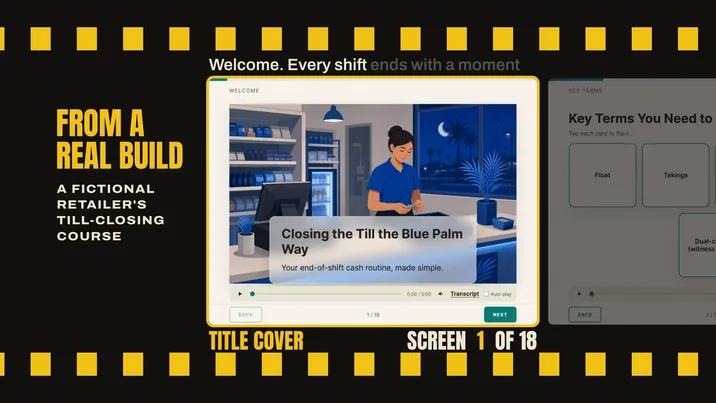
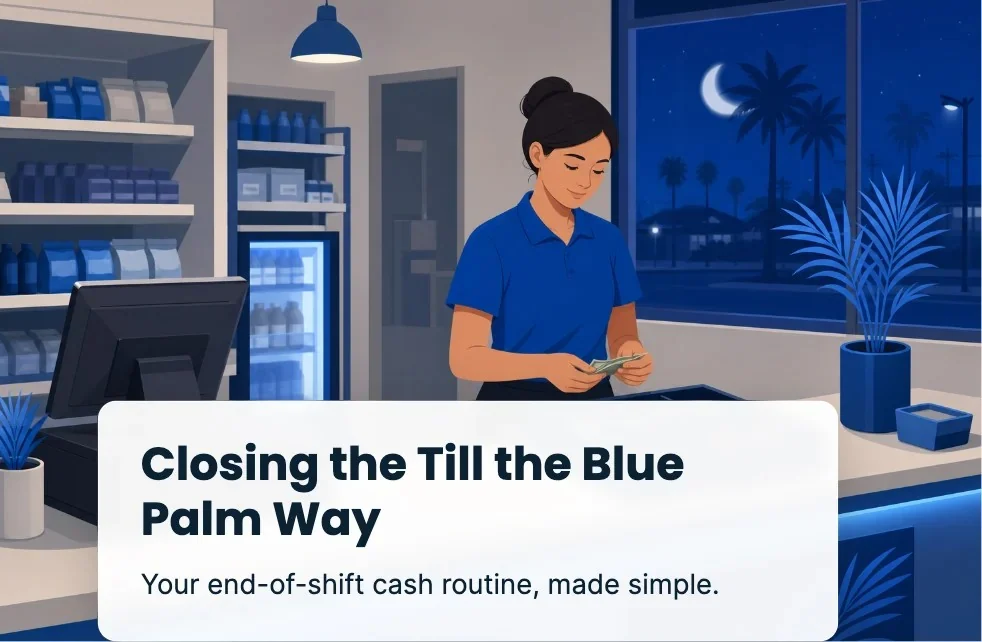
On screen: The opening screen of a finished course, Closing the Till the Blue Palm Way, sits in the gate. It is labeled as a real build of a fictional retailer’s till-closing course, screen 1 of 18, and the words of its narration light as they are spoken.
Course narration: Welcome. Every shift ends with a moment that matters more than most people realize: the close.
On screen: The film moves on a frame at a time through more of the course: flip cards, and one flips; a hotspot; a knowledge check; a branching scenario, and a choice is made.
[Film clicks through the gate]
On screen: Giant type fills the frame: 18 screens, one brief.
On screen: The title, E-Learning Pipeline, runs in on a strip of film, a letter to a frame. Under it, a card shows the first sentence of the brief, and three lines land: One brief goes in. One human review. One course comes out.
[The full band comes in] Give me one brief. After one human review, I hand back a finished, narrated course.
On screen: The plan. A storyboard of 18 blank, numbered frames lays out on three strips while a clock, labeled an estimate, counts down from ten minutes. Stop: nothing else gets built, and the clock holds. A hand brings down a stamp, Approved by a person, and the clock runs again.
I write the storyboard first. Then I stop. Nothing else gets built until a person approves it.
On screen: The crew. The 18 frames fill with their screens, then five panels run in, one over another, each with a real screen and a name: the screens, the knowledge checks, the branching scenarios, the illustrations, the narration. Beside the illustrations stands the course’s shop associate, stepped out of her picture as a paper cut-out. The clock reaches zero.
Then I build the rest: the screens, the knowledge checks, the branching scenarios, the illustrations and the narration.
On screen: Red. The word for Arabic in Arabic script, the words Right to left, and the course player’s own controls as the renderer draws them in Arabic. A film can rolls in: SCORM 1.2, ready for an LMS. A line of Arabic narration is written out, with its meaning: Module complete.
I do it in Arabic too: right to left, narrated in Arabic. Then I package it as SCORM. Arabic narration: (In Arabic) Module complete.
On screen: By Sheldon’s estimate: Ten hours is a job best done in ten minutes. Each line is inked as it is said, and the paper associate walks on carrying a bag.
By my maker’s estimate, ten hours of work by hand takes me about ten minutes.
On screen: Two panels close like doors. On the left, the poster for The E-Learning Pipeline. On the right: The E-Learning Pipeline, now showing. A Sheldon Smith production, story by one brief, screenplay by Claude, narrated in English and Arabic, packaged as SCORM, running time ten minutes. More than 3,000 automated tests.
The E-Learning Pipeline. Now showing. [The band climbs] [The band plays a run of short hits] [One last hit, and the chord rings out]